-
 Subscribe in a reader
Category Archives: Yosemite
How I See in the Field: Simple.

Ice Reflection, El Capitan, Yosemite National Park
Yosemite National Park is an interesting place to photograph. To call it iconic is an understatement. However, while the iconic vistas are a must do for photographers, the conditions must be amazing to make those images successful. After many years of visiting and observing this alluring valley, I’ve found that its beauty really lies in the subtle details found in the shadows of the “giants of the valley”. (I actually find this to hold true almost anywhere I explore!)
Now, here is where my style diverges from many. Most photographers, especially when shooting digital, will “work” a location. They will start quickly with multiple obvious images of the icon, even with mediocre conditions, and continue to change focal lengths and bracket exposures, capturing every possibility so as not to miss anything. This is more of a photojournalistic / must have volume immediately approach. I prefer to stay relaxed and open, observe, and see what I am drawn to, visually and emotionally. I don’t want to gather hundreds (or thousands) of snap shots in hopes of finding “something good” several days later while weeding through “the pile” on the computer. I am looking for one or two moving pieces of art. I want to ‘Bring the Fine Art of Nature Home”!
When I am drawn to a subject, I take my time. I don’t want to force it. I look at the main subject that grabbed my attention, and then look at the context. If I am still drawn to the subject, I see if there is a specific composition that feels right. If so, I take out my camera, choose a lens (my large format cameras only have fixed focal lengths) and look at the rough composition. Next I settle on my focal length, choose my perspective (camera height, distance from the subject, side to side angle, etc.) and finally, ELIMINATE anything I can from the composition. I prefer clean and simple. I then decide as to whether or not this composition still pulls me in. If so, it’s on to the technical stuff (which I keep minimal!).
Now that I have composed THE image, and the light is or will soon be ideal, I decide whether or not I need to use a filter. (Most often I am filter free, with a few exceptions: Split ND filters to even out exposures, polarizers for removing glare on wet rocks and foliage, and contrast filters for black and white film photography.) Finally, I calculate the exposure, load one sheet of film and capture one exposure.
The image above, Ice Reflection, El Capitan, is a stunning example of this process. With no clouds to make El Capitan appear unique and interesting in a more direct composition, I put myself in a position to explore something unique. I relaxed and maximized my chances by choosing this location (you can’t force it). I was there early, knew the light to expect, and just went with it. I walked along and let the shoreline ice grab my attention. I checked it out, moved around and watched the reflection change as I moved. The ice patterns alone were worthy of an image. When I was able to add the contrasting reflection of warm light on El Capitan with that of the blue sky, the dimension changed dramatically. For me, this image is now about pattern, detail, light, color and place. Amazing!
Notes:
I shot this image using my 4×5 inch film camera. This large format equipment has numerous benefits: The film size captures a huge amount of information. It is relatively slow to set up (encouraging me to be very considerate in my image choices). It is quite expensive to shoot (again encouraging me to be very considerate in my image choices). I can change the shape of the camera, and thus change the focal plane to match the image needs (this enables extreme critical focus and allows me to use the lens at its strongest working aperture). Each of these factors leads to the finest print quality available. I created one exposure. The exposure of the shot.
Importantly, this process of how I see, work with my large format gear and focus on “THE SHOT” is what has made me a successful gallery owner and workshop / tour leader. I am able to make photography a relaxing endeavor focused on the feelings that brought each of us to outdoor photography to begin with. I am eliminating the intimidation factor of technological overwhelm, and I am sharing the strong basic process of seeing, feeling and composing “The Fine Art of Nature”. When participants visit my gallery and view my large fine art prints on the wall, they find great relief in learning that you don’t have to be a computer engineer to do photography at the highest level. Please join me in the field!
Photo Tip:
The lesson learned here is one of the biggest I share with my workshop / tour participants. Relax, stay open and don’t force an image. The art of landscape photography begins with seeing in a way that communicates what we feel when we are lucky enough to experience natures beauty. Especially when we have travelled somewhere with the purpose of doing photography, the natural (modern) inclination is to shoot all we can. The reality is, the shot isn’t always there. I believe it is better to come away with a few beautiful, heartfelt pieces of art, than it is to grab hundreds (or thousands) of images that are mere snapshots. Furthermore, I never shoot with the mindset that “I can fix it later” or “make it art” in the computer. Enjoy the beauty in these inspiring natural places, immerse yourself in your surroundings, and use the basics to compose the art that moves you.
Equipment:
Canham 4×5 Metal Field Camera, Rodenstock APO Sironar-S 150mm lens, Fuji Provia 100 Transparency Film, Really Right Stuff BH-55 Ball Head, Gitzo 1325 Carbon Tripod, Sekonic Digital Spot Meter.
Private Workshops:
I am available for private individual or group workshops and tours near my home in Lake Tahoe, or anywhere in the world! join me when you are ready to take your photography to the next level, when you want a guide for the sweet spots of Lake Tahoe, or when you want to improve your photographic success on your next photo trip! Contact me directly: 530-544-4269 [email protected] www.jonpaulgallery.com
Seeing an Icon Differently (Firefall in B & W)

Firefall V.S. Silver Light
The Story:
The digital world is affecting landscape photography in many ways. Advances in digital equipment have made photography accessible and enjoyable for millions of people that never would have picked up a film camera. Digital communication has made many beautiful places “known” to the masses. This combination of factors is encouraging large numbers of people to make pilgrimages to these beautiful iconic spots with the purpose of re-creating images they have seen in magazines and on the web. While these locations have become icons for a reason (beautiful is beautiful!), there comes a time when they have been overdone. We can get so caught up in shooting a scene the way we expect to see it, that we often miss, or even consciously pass up, spectacular alternatives that Mother Nature presents to us in the exact same location. We shut down to the many possibilities that create real magic and excitement in nature.
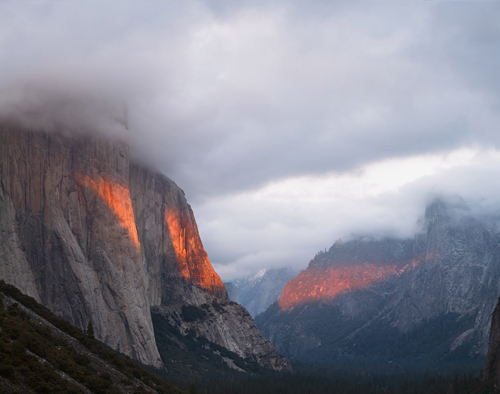
The above images are perfect examples of the iconic expectation v.s. an unexpected possibility. The image on the left, known as the “Fire Fall” is the expected image. During a brief window of only two weeks each year, the sun sets at just the right angle to illuminate Horsetail Falls, in Yosemite National Park, with beautiful sunset color as the cliffs on either side of the falls become shaded. While this image would have benefitted greatly from heavier water flow, it is still a pleasing representation of an iconic event. I like the image and will make it available to my collectors.
Now, let’s consider the black and white image on the right. I created this image while most other people were merely viewing the scene waiting for the expected “Fire Fall”. I noticed that the evening light, as it narrowed toward the middle of the cliff, gleamed with a magical silver light, creating what appeared to be an elongated heart around the waterfall. This light created a monotone scene, contrasting strongly against the shaded areas of the cliff face. Importantly, I felt this image, and envisioned it in black and white. Like most successful images, this was not an afterthought. I was emotionally moved to create this composition. There was purpose to my shooting (although unplanned). I had to do this! People kept asking what I was doing, and even after I shared what I was envisioning, they were quite content to wait for the same image the crowd was there to see. Fair enough. I now have an image that I am extremely moved by, and which is vastly more dramatic than the light show we had expected. Being open enough to allow your emotions to move you toward a vision is where “the fine art of nature” elevates photography to an art form.
The lesson here is, while it is certainly fine to let the possibility of an iconic image motivate you to visit a particular location, stay open to all possibilities that may present themselves. Often, the unexpected image is the one you will be most proud of. Don’t force the issue for the sake of being different, let it happen naturally. As you build experience, your personal style will develop. Be your own artist, not a copy of someone who has probably copied someone before them.
Enjoy the View!
Photo Tip:
Tip number one, as mentioned above, use available knowledge of iconic locations and conditions to get yourself to the “right spots at the right time”. THEN, stay very open for new and different photographic possibilities. While other people lay around during the day (usually working on the computer trying to make a mediocre shot “good”), get out and scout. I like to fill every available minute on my photo trips with “being out”. Drive the area, look at maps, hike to spots that may be interesting, go for a trail run or bike ride, etc. Figure out your own vision for the area and plan the right time to return to that spot. I like to use the outdoors as my gym. There have been many times when I have done a trail run or hike and come across a new and exciting subject. This shouldn’t feel “hard”. Stay open and see if something presents itself to you. It is very gratifying to “feel” an image. That is “the fine art of nature”. Compare that to how you feel when asking someone in the lineup of photographers, “is that it?”. (Personally, physical exertion opens my mind and spirit to what is around me in a very different and positive way, truly opening my eyes to what I feel!) As the example images above show, sometimes staying open and feeling your own vision simply entails seeing a version of the iconic shot in different light, or with different eyes.
Don’t let yourself get caught up in a technical mindset. Their are so many possibilities with digital photography that many people get caught up in the “engineering”. A majority of people that come to my workshops/tours are overwhelmed with all of the functions on their camera, their raw converter, Lightroom, photoShop, HDR software, etc. (This includes aspiring and current professionals!) They lose sight of the joy of being outdoors (which is why they wanted to take photos to begin with!) and composing pleasing images. The most talented and successful photographers in the world use the most simple of precesses. Research beforehand, scout, observe, shoot in the right light relative to your subject and your vision, compose well, expose properly. The digital darkroom is really a tool to simply fine tune a well executed image. Many people are confusing digital art with photography. Please consider joining me on a group or private workshop/tour. I’d be happy to help you simplify the photographic process, making it both more successful and more enjoyable!
Equipment Used:
Nikon D300 DSLR, Nikon 200-400 F4 AF VR, Gitzo 1325 Carbon Tripod, Really Right Stuff BH-55 Ball Head, Cable Release. PhotoShop CS4 used for stitching and B & W conversion.
New Workshops / Tours Update! (dates approaching)
Field Photography Workshops / Tours
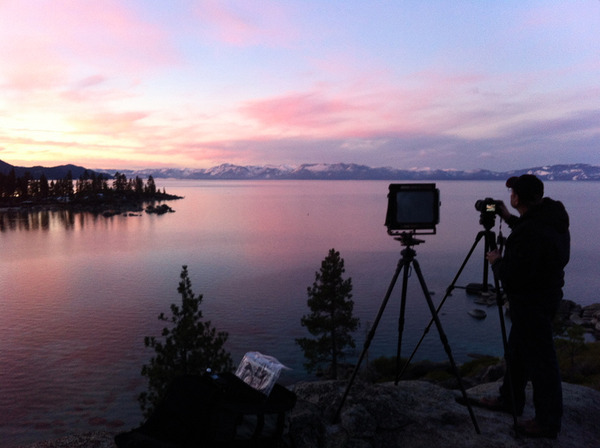
NEW- February 22-24 Yosemite Semi-Private Tour – SOLD OUT
I will only take 4 people, offering us amazing camaraderie and teamwork. The intention is to enable you to experience the type of photography experience often reserved for my close friends and fellow pros. This will be a budget friendly trip with total immersion into the photographic experience, day and night. We will share in decision making, scouting and shooting. Weather, as always, dictates our shooting choices. This is the right time of year to capture the famous “fire fall” (conditions permitting). While I will be shooting with you, my main focus is your learning experience! You come first. I get us there, get us set up and answer EVERY question. I am working for you:)
Call me for specifics and to reserve your spot 530-545-2896.
Cost: only $479
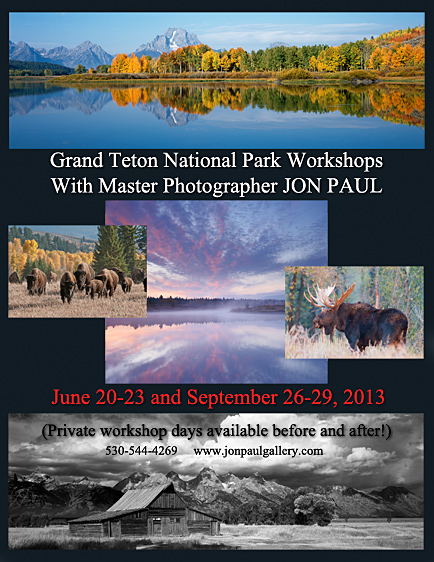
Grand Teton National Park Workshop / Tour Dates Set! (see flyer below)
Grand Tetons in the Spring, 2013:
June 20-23:
This will be a four day adventure focussing on iconic Teton landscape images, as well as wildlife photography (baby critters will be out and about). Along with putting us in the right place at the right time to capture our dream photos, I will be teaching about composition, exposure, light, perspective and proper technique. 100% of our time will be spent in the field, where we will learn while doing. While our days are long and tiring, they are also extremely rewarding both photographically and personally. Comeraderie is a huge part of our experience. We will have a great time in a world class wilderness environment and come away better photographers for it. This will be limited to a small number of participants so everyone has all the personal attention required to get the most out of the experience. This is not a physically demanding tour, but participants should be able to walk on uneven ground. You will be expected to rise early to start the day, and be considerate to the groups time requirements in order to ensure that we can meet our “magic light” timelines! Please call to discuss any details that may help you make your decision.
Dates: June 20-23, 2013
Cost: $975
530-544-4269
NEW Private Workshop Days available in both Grand Teton and Yellowstone!
I have added the option of private, one-on-one workshops, both before and after the official Grand Teton dates. I will offer these private sessions at the same price as my local private sessions!
Call to arrange your custom dates 530-545-2896.
Cost: only $500/day
I have added the option of private, one-on-one workshops, both before and after the official Grand Teton dates. I will offer these private sessions at the same price as my local private sessions!
Call to arrange your custom dates 530-545-2896.
Cost: only $500/day
Winter in Lake Tahoe
I have left a large number of dates open and available for private one-on-one or small group workshops / tours here in Lake Tahoe (or wherever you would like). This is a beautiful time of year to photograph Lake Tahoe, aspen groves, rivers, waterfalls, ice patterns, mist, black & white, sunrises and sunsets. The sun is low in the sky, providing soft light and long shadows. We can generally shoot a little later in the morning, and earlier in the evening. Snow and ice provide a new look to the land, and very different opportunities for familiar subjects. Composition and metering, along with managing the cold and snowy conditions, however, become unfamiliar. Join me in the field and allow me to share my experience with you. Let’s create some unique images, while I help you gain confidence in the snow covered photographic world!
Cost: $750/day only $500/day

Spring in Lake Tahoe
Dates will be announced shortly! Private workshops / tours are still available!
This is the most popular time of year to photograph Lake Tahoe! A majority of my signature Lake Tahoe images were composed at this time of year.
Often the lake is calm, providing iconic clear water images, along with beautiful sunrise and sunset reflections. Waterfalls are rushing with snow melt, rivers are full, and there are still very few visitors. We have the place to ourselves! Honestly, this is the stuff photographers dreams are made of:) Please join me, as I share the most outstanding locations to photograph in this region, along with my knowledge and understanding of the art of landscape and wildlife photography. As one of the few successful gallery photographers in the country, I have a different approach to this art. I am not attempting to create huge volumes of work to fill magazine space. Nor am I attempting to produce “digital art” from mediocre images. I will share with you the simple steps and tools necessary to capture “the fine art of nature”, eliminating the intimidation factor of the digital world. All questions are answered, as we learn by doing. Let’s look through the lens together, create amazing images, and learn to become more successful photographers in the field.

Follow Me


 Subscribe in a reader
Follow Us!