-
 Subscribe in a reader
Category Archives: Winter Photography
New Workshops / Tours Update! (dates approaching)
Field Photography Workshops / Tours
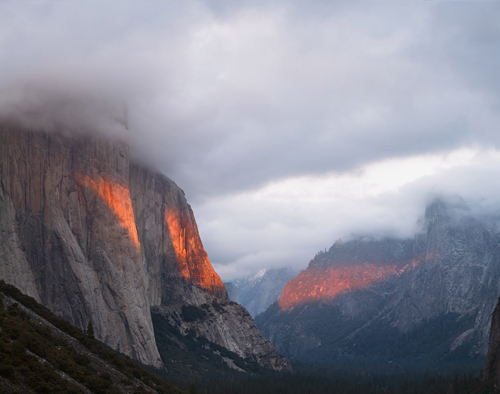
NEW- February 22-24 Yosemite Semi-Private Tour – SOLD OUT
I will only take 4 people, offering us amazing camaraderie and teamwork. The intention is to enable you to experience the type of photography experience often reserved for my close friends and fellow pros. This will be a budget friendly trip with total immersion into the photographic experience, day and night. We will share in decision making, scouting and shooting. Weather, as always, dictates our shooting choices. This is the right time of year to capture the famous “fire fall” (conditions permitting). While I will be shooting with you, my main focus is your learning experience! You come first. I get us there, get us set up and answer EVERY question. I am working for you:)
Call me for specifics and to reserve your spot 530-545-2896.
Cost: only $479
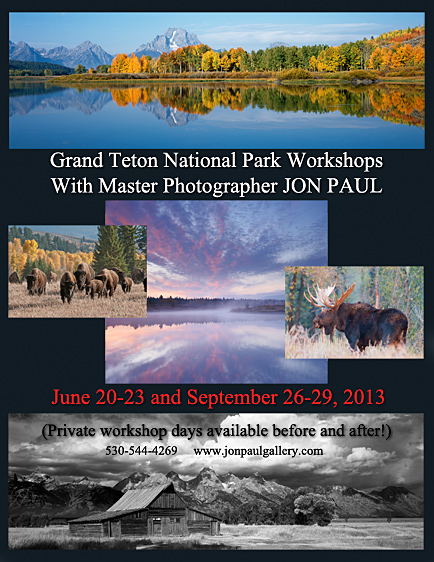
Grand Teton National Park Workshop / Tour Dates Set! (see flyer below)
Grand Tetons in the Spring, 2013:
June 20-23:
This will be a four day adventure focussing on iconic Teton landscape images, as well as wildlife photography (baby critters will be out and about). Along with putting us in the right place at the right time to capture our dream photos, I will be teaching about composition, exposure, light, perspective and proper technique. 100% of our time will be spent in the field, where we will learn while doing. While our days are long and tiring, they are also extremely rewarding both photographically and personally. Comeraderie is a huge part of our experience. We will have a great time in a world class wilderness environment and come away better photographers for it. This will be limited to a small number of participants so everyone has all the personal attention required to get the most out of the experience. This is not a physically demanding tour, but participants should be able to walk on uneven ground. You will be expected to rise early to start the day, and be considerate to the groups time requirements in order to ensure that we can meet our “magic light” timelines! Please call to discuss any details that may help you make your decision.
Dates: June 20-23, 2013
Cost: $975
530-544-4269
NEW Private Workshop Days available in both Grand Teton and Yellowstone!
I have added the option of private, one-on-one workshops, both before and after the official Grand Teton dates. I will offer these private sessions at the same price as my local private sessions!
Call to arrange your custom dates 530-545-2896.
Cost: only $500/day
I have added the option of private, one-on-one workshops, both before and after the official Grand Teton dates. I will offer these private sessions at the same price as my local private sessions!
Call to arrange your custom dates 530-545-2896.
Cost: only $500/day
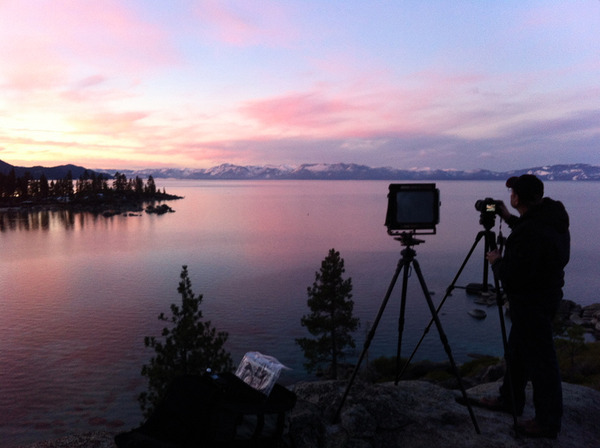
Winter in Lake Tahoe
I have left a large number of dates open and available for private one-on-one or small group workshops / tours here in Lake Tahoe (or wherever you would like). This is a beautiful time of year to photograph Lake Tahoe, aspen groves, rivers, waterfalls, ice patterns, mist, black & white, sunrises and sunsets. The sun is low in the sky, providing soft light and long shadows. We can generally shoot a little later in the morning, and earlier in the evening. Snow and ice provide a new look to the land, and very different opportunities for familiar subjects. Composition and metering, along with managing the cold and snowy conditions, however, become unfamiliar. Join me in the field and allow me to share my experience with you. Let’s create some unique images, while I help you gain confidence in the snow covered photographic world!
Cost: $750/day only $500/day

Spring in Lake Tahoe
Dates will be announced shortly! Private workshops / tours are still available!
This is the most popular time of year to photograph Lake Tahoe! A majority of my signature Lake Tahoe images were composed at this time of year.
Often the lake is calm, providing iconic clear water images, along with beautiful sunrise and sunset reflections. Waterfalls are rushing with snow melt, rivers are full, and there are still very few visitors. We have the place to ourselves! Honestly, this is the stuff photographers dreams are made of:) Please join me, as I share the most outstanding locations to photograph in this region, along with my knowledge and understanding of the art of landscape and wildlife photography. As one of the few successful gallery photographers in the country, I have a different approach to this art. I am not attempting to create huge volumes of work to fill magazine space. Nor am I attempting to produce “digital art” from mediocre images. I will share with you the simple steps and tools necessary to capture “the fine art of nature”, eliminating the intimidation factor of the digital world. All questions are answered, as we learn by doing. Let’s look through the lens together, create amazing images, and learn to become more successful photographers in the field.

Special Moments Transcend Mere “Picture Taking”

Spirit of Yellowstone
The Spirit of Yellowstone:
Yellowstone is a place that evokes great emotion in people who appreciate solitude in the wilderness. I happen to be one of those people. I arose early on my last Fall morning in Yellowstone and set out for a sunrise photo excursion. With cold temperatures at night, the Hayden Valley filled with mist from the steam rising off the Yellowstone River. With only the Bison and Elk sharing the valley, there was a feeling of solitude and peace that permeated the air. I found this quiet bend in the river that offered a visual translation of the tranquility I experienced at this perfect moment in time. Everything appeared soft, yet powerful, as the hint of sunrise color filtered through the mist and cloud. This is a truly special image. It is also an example of the type of experience that moves me to share my vision the way I do. My purpose in using the large format film cameras is to remind myself that my work is not about immediacy and volume. I only take my camera out when I am truly moved by a scene in nature that evokes an emotion I feel is worthy of sharing. When I believe a scene, combined with the light and atmospheric conditions present, have the possibility of transporting my viewers to a special place (inside or out), I know I am going to create a special piece of art. There is meaning in what I do, and my methods dictate how that meaning is presented and the impact that presentation has on the viewer. This is where my motto, “Bringing Home the Fine Art of Nature” was born. I hope this new image, as well as my others, brings you that inner peace I feel in these magical places!
Photo Tip:
Ironically, the simplicity of this scene is what gives it such great impact. The simplicity creates the ambiance. Quite often we will try to add everything we can into a scene; a strong foreground, a fiery sky, etc. This type of scene, which is based upon atmospheric conditions, has just enough landscape structure to draw the viewer in, and let the imagination run wild. The eye is drawn in along the river, through the mist, and around the corner disappearing into the distance toward the brightest part of the scene, the rising sun. With the simple foreground, we are left to wonder what is hidden beyond the bend, where we really wish we could go. The lesson here is, less is often more. Don’t force a composition, but feel it. Let it happen. Compose, with the camera locked on the tripod, then whittle away at everything that is unnecessary. Eliminate distractions whenever possible.
Equipment Used:
Canham 5×7 Metal Field Camera, Canham 6×17 cm panoramic film back, Rodenstock Sironar-S 150mm lens, Singh-Ray 2 stop split ND Filter (soft gradation), Really Right Stuff BH-55 Ball Head, Gitzo Carbon Tripod, Fuji Provia RDPIII 100 Transparency Film.

Red Barn and Pogonip
December brought extremely cold temperatures, freezing fog and a blanket of frost to the area surrounding Lake Tahoe. Knowing that these extreme conditions can create a special mood for the right composition, I spent three mornings searching within the pogonip for interesting “western” scenes. I had driven past this traditional red barn hundreds of times, but this is the first image I have composed of the structure.
The frosted trees, pogonip and diffused morning light add an air of history to the scene. I especially liked the way the mountain backdrop disappeared into the mist allowing my imagination to wander. The detail of the tree’s soft shadow on the barn is subtle, but intriguing. I much preferred this “softer” feeling image to the bright contrasty, literal scene I observed the previous morning. An iconic western scene became something special when paired with unique and dramatic natural conditions. Using the panoramic format enabled me to eliminate the clearing sky and retain the intimate feel I desired.
Tips: Given the extreme temperatures (about 5 degrees F) I kept my camera pack in the back of my truck as I explored, eliminating issues like fogging that can occur by taking the camera directly out of a heated vehicle. My camera backpack is padded, so the equipment cools slowly as I explore. In these frigid conditions, I always hold my breath when near the lens. Warm moist air that is breathed out will coat the lens and immediately freeze and will take precious time to thaw. Wiping a frost covered lens can create scratches and damage a modern lenses coating. To protect myself, I was using a new pair of fleece gloves that had pile on the inside, but a smooth weave on the outside. They were thin enough to handle the controls on my bellows camera, but still kept my fingers from becoming frost bitten. Finally, watch your exposure in foggy conditions. This type of scene often requires an exposure compensation of +1/2 to +1 full stop. I usually cross reference my spot metering with an ambient reading. If shooting digital, watch the left side of your histogram.
Winter Solitude: An New Look at a Familiar Location

Winter Solitude Panorama
There is nothing more calming than the quiet one can experience while snow falls from the sky and blankets the landscape. That was the case on this amazing snowy morning at Emerald Bay. The only sounds were that of the snowflakes hitting my hood, and the somewhat distant roar of snow melt pouring over Eagle Falls into Emerald Bay. The blanketed landscape has a surreal feel as the forested mountains disappear into the snowy distance. While the mountains across the lake are obscured by the veil of snow, Fannette Island can be seen far below, framed by the snowy branches of the foreground Cedar tree. I feel a Zen like peace at moments like these. It is my goal to compose images that translate that feeling to you and enhance your life the same way these experiences enhance mine. Enjoy the view! (and the experience)
Tips for shooting in these Conditions:
I find that inclement weather (like these snowy conditions) often make for the most unique and emotion evoking images. I try to stay prepared so I can successfully capture the image I envision while maintaining the health of my equipment. I keep a clear plastic bag in my camera pack at all times, and leave a travel umbrella in my truck. Since we all get to our shooting location early…I drape the bag over my tripod mounted camera after setting up and refining my composition. The bag keeps everything dry while I patiently wait for the light. When I am just about ready to shoot I remove the bag and hold the travel umbrella above my setup. When moving the umbrella for a clear shot, the lens can get wet. For this, I kep a chamois handy. My LowePro AW backpack has a built in rain fly, which I use while hiking, as well as covering the open pack on the ground while shooting. As with most situations, I find it best to have a set process (that I make a habit) to follow in every situation. This minimizes confusion and alows me to focus on creating the image I envision. I have a place for everything in the pack, and when I set up, specific items go in the same pockets, ready to use, every time.
Finally, exposure in rain and snow can be tricky. When shooting digitally, review the histogram and make sure your exposure is correct, then compensate if necessary. Since I shoot with large format film, I do some exposure averaging with my spot meter, as well as an ambient reading, to come up with my exposure. Experience helps greatly. I recommend to my seminar students that they not only check the histogram to get that one exposure correct, but observe the conditions and take note of how their camera meter reacts in those particular conditions. This will help you make an education exposure compensation in conditions that change quickly and only offer one exposure. Join me in the field to learn more!
For this image I chose to use my Fuji GX617 panoramic rangfinder camera, as I didn’t require the precise use of split neutral density filters. This made dealing with the conditions a bit easier that using one of my view cameras. Glad I had the choice:) As always, my camera was locked onto a carbon fiber tripod and heavy duty ball head.
Follow Me


 Subscribe in a reader
Follow Us!